

Summary
- A nationwide dairy strike has halted about 20% of Israel’s milk production, leaving supermarket shelves empty and prompting purchase limits for consumers.
- With traditional milk scarce, cow‑free dairy brands like New Milk are seeing heightened visibility.
- The crisis could help accelerate the adoption of precision‑fermented dairy.
Israel is in the midst of a nationwide milk shortage after farmers went on an indefinite strike this month.
Around 20% of dairy supply has been halted over proposed reforms that risk lowering consumer prices and jeopardising the livelihoods of at least 400 dairy farms.
The move is unprecedented and has resulted in empty supermarket shelves, with milk and fresh dairy products such as cottage cheese and cream all affected.
But disruption may have a surprising upside for an emerging corner of the dairy space: animal-free milk.
What’s animal-free dairy: and what does it have to do with Israel?
Israel has shaped up as a food tech hub fronting alternative protein innovation including dairy, meat and fish alternatives. Start-ups including ImaginDairy, Remilk, Aleph Farms, and ChickP all hail from the country.
In the dairy space, precision fermentation dairy firms ImaginDairy and Remilk made waves last fall with the release of Israel’s first cow-free dairy products to land in retail.
The category promises to be a sweet spot between conventional dairy and plant-based alternatives by offering dairy-identical taste and functionality while still being vegan. The products are typically made with precision fermentation-derived proteins that are genetically-identical to traditional dairy: meaning they are produced in fermentation tanks, rather than derived from an animal.
And last fall, Israel saw the first cow-free dairy products enter retail.

ImaginDairy’s BLG protein that is a core ingredient in the dairy-identical milk and cream alternatives sold by grocer Strauss Group, while Remilk partnered with Gad Dairy to introduce New Milk, a barista-style milk alternative.
The launches already played an important role as case studies for consumer acceptance of animal-free dairy.
But with shortages leaving gaps in the milk aisle, the absence of traditional options will naturally heighten the prominence of this emerging category.
A cowless milk supply
“The current milk shortage in Israel means that many supermarkets are limiting the number of bottles that consumers can buy,” Aviv Wolff, CEO and co-founder of Remilk, told us. “It also means that consumers are now facing supermarket shelves empty of traditional milk.”
But even before this week’s developments, Remilk’s bottles were “selling out at a steady clip”.
“We were seeing a far more overwhelming response to the supermarket launch than we could have imagined,” he added. “The ultimate test for a new product is whether it systematically appears on customers’ shopping lists. The positive reviews have included the many factors that one judges when trying a new dairy experience: taste, texture, functionality.”
There’s another key USP for cow-free milk in Israel: it can be served together with a meat-based meal, which is otherwise strictly forbidden to those who observe Jewish dietary laws.
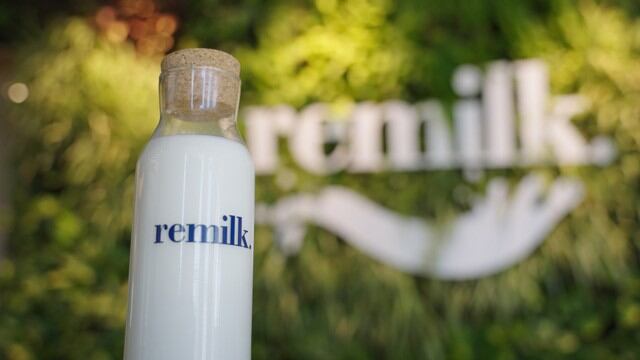
Consumer acceptance has been ‘excellent’. “We have been privileged to receive outstanding consumer reviews, ranging from taste to texture to overall experience, from across the country,” said Wolff. “The enthusiasm on social media and regular media is hard to miss.”
The shortages inevitably put the spotlight on those products, too.
“Obviously, the current situation further underscores the advantage of a cow-impervious supply chain,” Wolff said.
“We are in ongoing contact with our production facilities, ramping up production to meet the sharp demand. This applies both to the fermented protein and the finished milk product.
“Remilk and our partners are doing our best to keep the pace to meet the increasing demand: keep in mind that this is a nationwide shortage.”
Next, Remilk is aiming at cultivating long-term customer loyalty and launching new formats.
“Additional New Milk products are expected to enter the market in the coming months,“ Wolff told us. ”This will strengthen the position of New Milk as not just milk to drink with your coffee every morning, but as a whole new dairy category.”
Can cow-free take off in 2026?
The animal-free dairy space is looking to bounce back after a couple of testy years for the sector, which has faced a tough regulatory and investor landscape.
European start-up Formo expanded its leadership team as it looks to ramp up industrialization this year, and Those Vegan Cowboys is eyeing a US launch after closing a recent funding round.
Confidence from Israel’s retail trials could help prop up the sector this year.
Strauss Group, for one, has signaled belief that the category can stand on its own in the future. CEO Shai Babad told this publication during an investor call in November 2025 that all cow-free products formulated alongside ImaginDairy had sold out.
But the limited nature of the current retail trial means it would take several quarters before the Israeli multi-national can draw meaningful conclusions regarding demand and sales performance.
“Right now, there’s not even a point in talking about revenues or demand. We’ll need a couple more quarters before we actually have some data and really understand [the market],” Babad said.
“But we do believe cow-free can grow to be a very big category in Israel, to be a solution not just in milk drinks and spreads but also in yogurts and desserts and in any dairy product that we have today.”


