


The US food color transition explained:
- Replacing synthetic dyes is a supply chain transformation, not simply a reformulation exercise.
- Demand for non-FD&C colorants could rise by 400% to 500%, outstripping current agricultural and processing capacity.
- Nationally consistent rules, realistic deadlines and coordinated investment will be critical to preventing shortages, higher costs and product disruption.
Lucky Charms and Trix have lost their certified colours. General Mills has now removed petroleum-based dyes from every cereal in its US portfolio, completing one of the food industry’s most closely watched reformulation pledges.
The food manufacturer had already stripped certified colours from its K-12 school foods in March. It says 90% of its US retail portfolio has now made the transition, leaving categories including fruit snacks and baking products to be converted by the end of 2027.
That’s an important achievement for a business whose brightly coloured cereals are recognised as much by appearance as taste. It also risks creating the misleading impression that removing synthetic dyes is becoming routine.
A major new report commissioned by the National Confectioners Association (NCA) and conducted by RTI International challenges that assumption. It suggests corporate colour commitments are racing ahead of agricultural supply, processing capacity and technical reality, raising the possibility that the ingredients needed to fulfil them won’t exist at the required scale.
A $57.8bn market is chasing the same alternatives

The FDA’s industry pledge tracker now reads like a roll call of America’s largest food businesses. General Mills, Kraft Heinz, Nestlé USA, Conagra, Tyson Foods, Hershey, Grupo Bimbo, Kellanova, Utz Brands, McKee Foods, Campbell’s and JM Smucker have announced commitments that largely fall between 2026 and the end of 2027.
Walmart intends to remove certified colours and more than 30 other ingredients from its US private-label foods by January 2027. Target has completed its removal of synthetic colours from the cereals it sells. The American Bakers Association has committed to eliminating certified FD&C colours from baked goods supplied to K-12 federal meal programmes from the beginning of the 2026-27 school year.
But while the FDA’s tracker shows momentum, it doesn’t show readiness. It records corporate promises without revealing whether replacement ingredients have been contracted, factory trials have succeeded or enough global production capacity exists.
According to the NCA’s Recoloring the US Food Industry’s Future report, FD&C colours appeared in around 4% of products sold through US off-premise retailers in 2025. Those products generated $57.8bn, equivalent to 7.1% of total food and beverage sales.
Beverages accounted for 28.9% of sales involving FD&C-coloured products, followed by candy at 22.4%, savoury snacks at 19.6% and sweet snacks at 17.9%. In confectionery alone, products containing these dyes represented 28.7% of available candy products and 42.2% of candy sales.
These aren’t decorative ingredients sitting inside commercially irrelevant lines. They support products generating billions of dollars and frequently provide colours that are inseparable from brand identity.
The US certified approximately 21.4 million pounds of red, yellow, blue and green FD&C dyes in 2025. The non-FD&C market, by comparison, reached around 12 million pounds after growing only gradually from 2021.
Yet matching an FD&C dye can require ten times as much non-FD&C colourant or more because plant-derived alternatives are generally less concentrated. Comparing existing market volumes therefore significantly understates the potential shortfall.
The commercial response suggests colour suppliers see the same capacity squeeze. Sensient Technologies is investing up to $250m to expand its natural-colour manufacturing, supply chain and workforce, including another 28,800 square feet at its St Louis facility.
Sensient CEO Paul Manning calls the conversion “the single largest opportunity in the company’s history”. He says approximately $100m of Sensient’s synthetic-colour revenue could eventually convert to natural alternatives at an average revenue multiple of around 10:1 because manufacturers need considerably more colourant to reproduce the same shade.
According to RTI, industry participants consulted for the research estimate a complete US transition could increase demand for non-FD&C colourants by 400% to 500%. The Institute concludes that today’s agricultural base and processing capacity couldn’t support growth of that magnitude without extensive new investment.
“This research makes clear that replacing synthetic food dyes is far more than a reformulation challenge – it’s a supply chain transformation,” adds John Downs, president and CEO of the NCA.
“The ingredients, agricultural capacity, manufacturing systems and infrastructure needed to support this transition cannot be built overnight. Companies need regulatory certainty before they can make the long-term investments required to expand supply, strengthen domestic manufacturing and ensure products remain safe, affordable and available for consumers.
“That’s why nationally uniform, science-based food safety standards are so important.”
The 2027 targets may consequently demand much more than faster reformulation. Unless investment rapidly reaches farms, processors and extraction facilities, the industry’s promises could prove incompatible with the physical amount of colour available.

What exactly are FD&C colours?
Certified FD&C colours are synthetic dyes regulated under the Federal Food, Drug and Cosmetic Act and approved for use in foods, beverages and other products.
Six remain authorised for widespread food use in the US: Red 40, Yellow 5, Yellow 6, Blue 1, Blue 2 and Green 3.
The price modelling should alarm manufacturers
Naturally sourced colour doesn’t mean locally sourced colour. Many alternatives depend on niche crops produced within highly concentrated global supply chains.
Non-FD&C reds, yellows, oranges, blues and greens can be produced from beetroot, black carrots, paprika, turmeric, annatto, saffron, red cabbage, marigolds, spirulina and butterfly pea flower. Carmine is derived from cochineal insects.
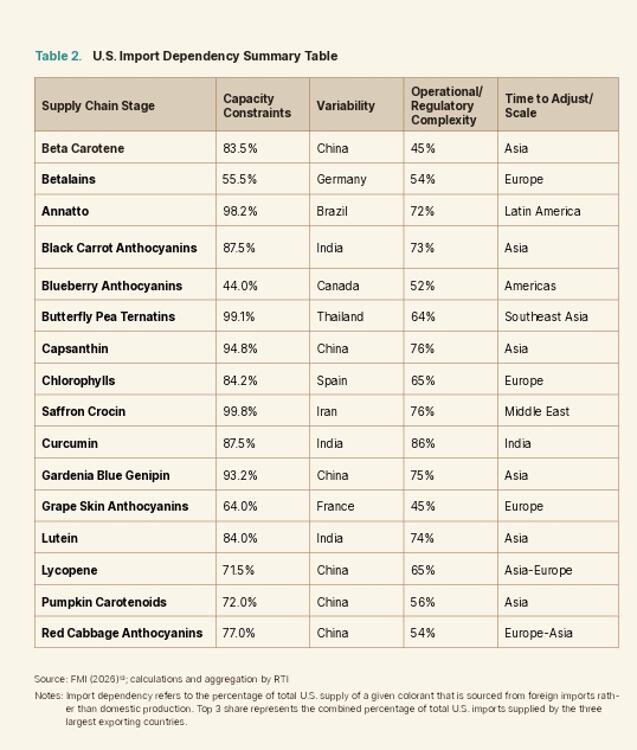
The NCA report estimates the US is 98.2% dependent on imports for annatto, 99.1% for butterfly pea and 99.7% for saffron. China reportedly supplies 76% of imported capsanthin, the red pigment associated with paprika, and 75% of gardenia blue genipin. India supplies approximately 86% of curcumin and 74% of lutein.
These figures describe US sourcing, but the repercussions don’t stop at the border. American manufacturers are competing for crops, extracts and processing capacity already supplying food producers elsewhere. A sharp increase in US purchasing could tighten availability and lift prices across the global market.
Michael Kreuzer, president of natural colour supplier Oterra US, believes larger manufacturers that move first will gain an advantage in both supply and technical expertise.
“The later you start the conversion, the greater the risks – and the chances that costs are higher and supply more limited,” he says.
Oterra says natural colours must be grown rather than manufactured, which means suppliers need sufficient notice to contract additional acreage or secure alternative production regions. The company expects US demand to accelerate faster than it did during Europe’s earlier transition, placing additional pressure on producers serving multiple markets.
Removing synthetic dyes could therefore exchange one perceived formulation vulnerability for exposure to extreme weather, crop disease, geopolitical tension, trade disruption, shipping delays and variable agricultural quality.
Expanding US cultivation offers no immediate escape. American farmers won’t surrender established acreage to niche colourant crops without long-term contracts and credible returns. Extraction capacity must also be built close enough to growing regions to prevent harvested material losing valuable pigment before processing.

RTI modelled three US demand scenarios through to 2028. The first reflects baseline growth driven by existing projections and policy signals. The second assumes demand reaches approximately 2.5 times its current level as retailer mandates and major-brand reformulations accelerate. The third is a fourfold-demand stress test representing an effective removal of synthetic colours within a compressed period.
These are directional models rather than forecasts. RTI relied partly on proxy crops and estimated supply responses because commercial data for many colourant crops are limited. Its highest figures aren’t inevitable, but their scale exposes how severely an accelerated transition could test the market.
Under the baseline scenario, the average price of the non-FD&C colourants modelled would need to rise by 53% to stimulate sufficient supply. The accelerated scenario produces an average increase of 516%, while the fourfold-demand stress test pushes that average beyond 1,000%.
Curcumin presents the most extreme case. RTI estimates that baseline demand growth of 26% would require a 277% price increase. The increase reaches 1,600% under accelerated demand and 3,200% in the fourfold scenario.
The accelerated model also produces increases of 926% for lutein, 860% for annatto, 856% for butterfly pea, 539% for chlorophylls and 497% for saffron.
These figures, however, don’t predict equivalent retail inflation because colour represents only one part of a product’s cost. Manufacturers can change recipes, accept different shades or remove colour altogether. Nevertheless, the modelling shows how poorly equipped agricultural supply is to absorb an industry-wide switch.
Imports would carry much of the strain. Average additional imports across the modelled colourants increase from 34 metric tonnes in the baseline scenario to 366 tonnes under accelerated demand and 733 tonnes in the fourfold case. Domestic supply responds much more slowly.
Pumpkin-derived carotenoids alone could require an additional 22,375 US acres under accelerated demand and 44,750 acres under the highest scenario. Those figures are small beside total American farmland, but enormous for crops without established colourant infrastructure.
Big Food can announce a deadline in a press release; it can’t, however, order thousands of acres, specialist extraction plants and experienced growers into existence.
Removing the dye could mean rebuilding the product
Securing sufficient colour doesn’t solve the manufacturing problem. Non-FD&C alternatives aren’t drop-in replacements and can react differently to heat, light, oxygen, acidity, moisture and other ingredients.
A shade that performs convincingly during development may fade in storage, bleed into another component during production or look markedly different after months under retail lighting. Turmeric and spirulina can present particular stability and handling difficulties.
Manufacturers may have to change processing conditions, flavour systems, packaging, warehousing and distribution. Transparent packs could need to become opaque to block light, while shorter shelf lives could demand tighter inventory controls and increase waste.
RTI puts reformulation expenditure at between $50,000 and $500,000 per SKU once product development, stability testing, sensory work and regulatory review are included. That quickly becomes a multimillion-dollar programme for a multinational with hundreds of recipes, pack sizes and production sites.
Smaller manufacturers face the same technical burden without equivalent purchasing power, specialist teams or financial tolerance for failed factory trials. Shelf-life validation typically takes around 12 months, with some products requiring 18 to 24 months. Developing and validating a new colour system can take three to four years or longer.
Removing certified colours also introduces different safety considerations. FD&C dyes undergo FDA batch certification, whereas non-FD&C ingredients don’t pass through an equivalent system and may carry risks involving pathogens, heavy metals, adulteration and weak traceability.
Sensient expects demand for botanical colourants to peak sharply across 2026 and 2027 and warns that testing failures involving contamination and adulteration could increase as suppliers rush to meet it.
The company describes the US conversion as “the biggest market shift the colour world has ever seen” and says the market is still expected to strain while it adjusts, despite years of preparation. It also stresses that natural colours aren’t covered by a single universal testing standard comparable with FDA batch certification for synthetic dyes.
The transition will require stronger supplier audits, contamination controls, specifications and traceability, rather than merely a different ingredient declaration.
Technology may eventually loosen agriculture’s grip on supply, but it won’t rescue every 2027 pledge. Oterra has entered a multimillion-dollar partnership with biotechnology company Debut to develop a precision-fermented alternative to Red 40, with commercial-scale availability targeted within three years.
“If we manage the supply chain of the fermentation flow, it should be stable quality and not dependent on weather,” says Luc Ganivet, Oterra’s head of innovation.
Fermentation could ultimately produce more consistent colours at scale while reducing exposure to crop failures and price volatility. However, the three-year development timetable reinforces the article’s central tension: some of the technologies capable of solving the supply problem won’t arrive until after many corporate deadlines have passed.

The report was commissioned by the NCA, whose confectionery members are particularly dependent on bright, consistent colours and have an obvious interest in practical deadlines and uniform national regulation. Its extreme models require scrutiny, but neither the sponsor nor the limitations of the data erase the underlying capacity problem.
There are encouraging signs from consumers. Sales of products carrying a ‘natural colours’ label increased by 24.4% between 2024 and 2025, compared with growth of just 0.1% for products declaring artificial colours. In candy, the respective increases were almost 20% and 0.2%.
PepsiCo’s Simply NKD Doritos and Cheetos generated more than $3m during their first month, although they were launched alongside established products rather than replacing them. Atkinson Candy Company recorded a 60.3% increase in Chick-O-Stick sales between 2020 and 2025 after beginning its transition away from FD&C colours in 2019.
Neither example proves that colour removal caused the sales growth, but both indicate that consumers won’t automatically reject a reformulated product.
General Mills has demonstrated that highly visual, instantly recognisable cereals can change. What it hasn’t proved is that the whole industry can repeat the exercise simultaneously without shortages, soaring ingredient costs or new sourcing vulnerabilities.
America has created a wall of colour pledges, and the reckoning is already under way.
The companies now racing to meet 2027 deadlines are discovering that removing a dye from an ingredient list is considerably easier than building the farms, factories and safeguards needed to replace it.
What needs to happen next?
According to NCA and RTI, replacing FD&C colours requires coordination across the entire supply chain – not simply product reformulation. Its recommendations include:
* Establishing uniform national standards and realistic transition timelines
* Expanding domestic production of colorant crops and extraction capacity
* Securing long-term agreements between growers, suppliers and manufacturers
* Improving the stability of alternatives exposed to heat, light, oxygen and varying pH
* Prioritising simpler reformulations while developing solutions for more complex products
* Coordinating packaging, labelling, distribution and retail changeovers to avoid stranded stock
* Investing in precision fermentation and other scalable production technologies
* Preparing consumers for potential differences in colour, price and product performance
Without this coordination, RTI warns the transition could bring higher costs, inconsistent state compliance, supply shortages and unnecessary waste.
